
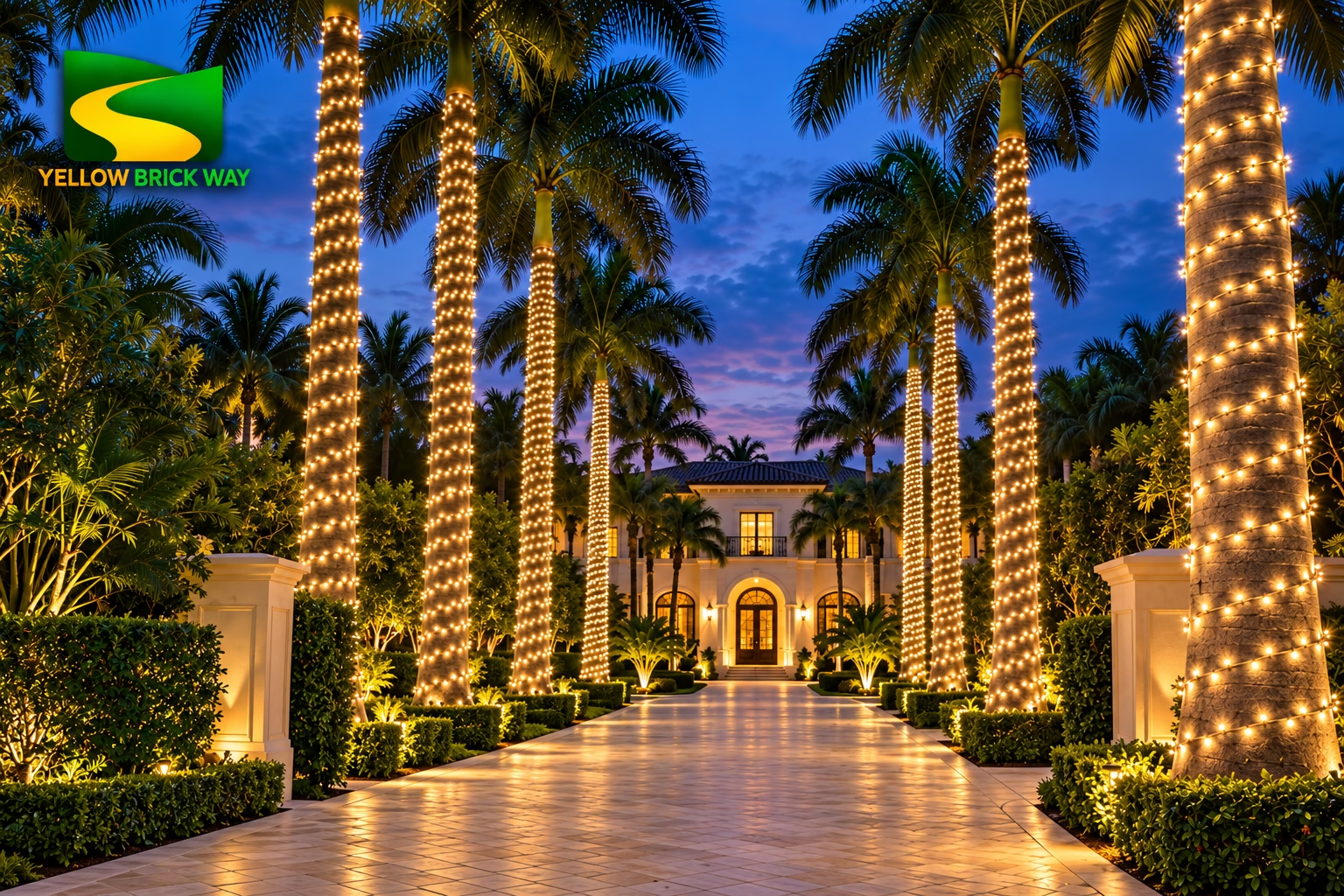
For a palm trunk with 12 feet of planned lighting coverage and a 3-foot circumference, estimate about 72 feet of lighted string at 6-inch wrap spacing, or 108 feet at 4-inch spacing. These are starting estimates for the trunk only; connection leads, the diagonal route, irregular surfaces, and any canopy lighting require separate allowance.
The right quantity of palm tree Christmas lights depends on what you plan to illuminate, not simply how tall the tree is. A slender palm beside a driveway and a thicker palm near a waterfront entrance can need very different amounts of lighting, even when their visible trunks are the same height.
For South Florida homeowners, the goal is a balanced display that complements the property without wasting materials or compromising the palm. Start with measurements, then choose the spacing and light strings that suit your design.
How to Calculate Lights for a Palm Tree
You need three measurements:
- Wrapped height: the vertical section of trunk you intend to light, excluding the fronds and crown.
- Trunk circumference: the distance around the trunk, not its diameter.
- Wrap spacing: the vertical gap between successive turns of the light string.
Measure the circumference at an accessible point. If the trunk changes width noticeably, estimate different sections separately. Keep height and circumference in feet, and convert wrap spacing from inches to feet by dividing by 12.
A practical starting formula is:
Approximate lighted length in feet = (wrapped height ÷ wrap spacing in feet) × trunk circumference in feet
This estimates the horizontal distance around all the wraps. The actual spiral is slightly longer, so treat the answer as a planning baseline rather than an exact purchase quantity.
Example: A 12-Foot Trunk Section
Suppose you want to light a 12-foot section of trunk with a 3-foot circumference and 6-inch gaps between wraps:
- Convert 6 inches to 0.5 feet.
- Divide 12 by 0.5 to get approximately 24 wraps.
- Multiply 24 by 3 to get 72 feet of lighted string.
At 4-inch spacing, the same section needs approximately 108 feet. That is about 50% more string for a denser look, without changing the tree.
Palm Tree Lighting Estimate Table
| Trunk height to wrap | Trunk circumference | Approximate lighted length at 6-inch gaps | Approximate lighted length at 4-inch gaps |
| 8 feet | 2 feet | 32 feet | 48 feet |
| 12 feet | 3 feet | 72 feet | 108 feet |
| 16 feet | 4 feet | 128 feet | 192 feet |
These are calculated examples, not standard requirements for particular palm species. They assume a roughly uniform trunk and exclude power leads, canopy lighting, and installation allowance. Actual dimensions and the route of the string determine the final amount.
For several palms, calculate each one individually and add the results. Matching wrap spacing can give a driveway a consistent appearance, even when the trees need different quantities.
How Many Bulbs or Light Strings Should You Buy?
Feet of lighted string, bulb count and the number of sets are different measurements. Check the packaging before converting one into another.
Bulb Count Depends on Bulb Spacing
For an approximate bulb count:
Estimated bulbs = lighted length in feet × (12 ÷ bulb spacing in inches)
For example, 72 feet of lighting with bulbs approximately 4 inches apart gives about 216 bulbs. At 6-inch bulb spacing, the same length gives about 144 bulbs.
This is a planning estimate. The first and last bulb positions and the unlit lead lengths vary by product, so use the manufacturer’s stated lighted length and bulb count when selecting sets.
Count Strings by Their Lighted Length
A string advertised as 30 feet long may include an unlit lead. Only the illuminated section provides the coverage used in the calculation.
For the 72-foot example, choosing a 10% planning allowance gives 79.2 feet, which you could round to an approximately 80-foot material target. If a compatible product provides 25 feet of lighted length per set, four sets provide 100 feet in total.
That does not mean all 100 feet must be wrapped onto the trunk. The final layout must account for connectors and surplus length according to the product instructions. Do not cut, splice or modify a light set unless it is specifically designed for that purpose.
The allowance is a planning choice, not a universal installation requirement. Irregular trunks, different connection layouts, or a wider design can require a different amount.
Choose Wrap Spacing for the Look You Want
Closer wraps create a denser pattern and require more lighting. Wider wraps use less string and leave more visible trunk between turns.
Compare the proposed spacing with the property’s roofline lighting, nearby landscaping and viewing distance. A brightly wrapped palm at the entrance may suit a focal point, while repeating that density across every tree can overwhelm a restrained design.
For a cohesive display:
- Keep the selected wrap spacing consistent across the planned trunk section.
- Compare warm-white samples before mixing different product lines.
- Decide whether the palms should lead the display or support the architecture.
- Review the design from the driveway and main approach, not only beside the trunk.
The measurements work the same way for properties in Boca Raton, Fort Lauderdale, Miami and West Palm Beach. The design should respond to the individual property.
For visual inspiration, explore the Yellow Brick Way holiday lighting gallery.
Plan Trunk Lighting and Canopy Lighting Separately
The trunk formula does not calculate lighting for the fronds. Canopy designs depend on the number, length, position, and movement of the fronds, as well as access and suitable attachment methods.
Decide whether you want a trunk-only display or additional canopy illumination before purchasing materials. Adding an arbitrary extra string for the entire crown can leave the design uneven and the material estimate inaccurate.
Tall crowns and difficult access are reasons to involve a professional installation team. Avoid climbing a palm or reaching into the crown to obtain measurements.
When comparing options, ask for the quote to distinguish trunk coverage, canopy work and the route to the power supply. Our guide to DIY versus professional holiday lighting installation explains the broader differences in time, access and ongoing support.
Choose Outdoor Lights and Protect the Palm
Outdoor use, electrical connections and tree care matter as much as quantity.
The U.S. Consumer Product Safety Commission’s holiday decorating guidance recommends safety-tested lights, outdoor-rated products, and extension cords appropriate for their intended use. Outdoor holiday lighting should use GFCI-protected power, and damaged light sets should be discarded.
Follow the manufacturer’s maximum end-to-end connection limit. The number of strings needed to cover a palm does not tell you how many can safely connect in one run. Product limits and the electrical circuit must both be considered.
LED strings are worth considering for seasonal displays. The U.S. Department of Energy’s explanation of holiday lights describes their lower energy use compared with traditional incandescent strings. Check the selected product’s actual wattage rather than estimating power demand from bulb count alone.
Avoid Attachments That Wound the Trunk
Do not use nails, staples or climbing spikes to install palm lighting. UF/IFAS explains in Palm Morphology and Anatomy that trunk wounds are permanent in palms.
Choose an attachment approach suited to the tree and product that avoids puncturing living tissue or binding tightly against it. Do not strip attached leaf bases or cut healthy fronds simply to make space for lights. Plan careful removal with the installation.
For South Florida properties, inspect the proposed connection locations around irrigation, standing water and exposure to rain. Follow the product instructions for outdoor connections instead of assuming that a light string’s outdoor rating makes every connector arrangement suitable.
If weather has damaged the palm or surrounding area, address that before decorating. Our South Florida hurricane-to-holiday preparation guide covers the broader planning considerations.
When Professional Palm Tree Lighting Makes Sense
Professional planning is particularly useful when a display involves tall palms, multiple trees, canopy work, difficult access or integration with an estate’s roofline and landscape lighting.
A useful proposal should explain:
- Which trunk sections and trees will be illuminated.
- Whether frond lighting is included.
- The light type, colour and planned wrap spacing.
- How power connections and access will be handled.
- What seasonal maintenance, removal and storage include.
Yellow Brick Way Holiday Illuminations and Landscape Lighting serves residential estates, commercial properties and event venues across Palm Beach, Broward and Miami-Dade counties. Its South Florida holiday lighting services cover custom design, installation, seasonal maintenance, removal and storage.
Start the conversation with the number of palms, accessible measurements, property photos and the appearance you want. Those details provide a clearer basis for a custom proposal than a single estimate of overall tree height.
Frequently Asked Questions
Q1. How Many Christmas Lights Does a 20-Foot Palm Need?
Measure the section of trunk you intend to illuminate. If that section is 20 feet tall, has a 3-foot circumference and uses 6-inch wrap spacing, the starting estimate is approximately 120 feet of lighted string. A different circumference or spacing changes the answer; canopy lighting is additional.
Q2. Is Wrap Spacing the Same as Bulb Spacing?
No. Wrap spacing is the vertical distance between successive turns around the trunk. Bulb spacing is the distance between bulbs along the string. Both influence the appearance, but they affect the calculation differently.
Q3. Can I Connect All the Strings Needed for One Palm?
Only if the manufacturer’s connection limit and the electrical setup permit it. Coverage calculations do not establish electrical safety. Check the selected product’s instructions and seek qualified electrical advice if the circuit capacity or outdoor power arrangement is unclear.
Should Every Palm Use the Same Number of Lights?
No. Different trunk dimensions can require different amounts. For a coordinated design, aim for consistent spacing and a complementary appearance rather than identical bulb counts.
Ready to plan your property’s display? Request a complimentary Yellow Brick Way consultation to discuss palm lighting as part of a custom South Florida holiday design.